In Jyotish Tarot, the Rāśhis represent more than personality traits or zodiac symbolism. They are living patterns of consciousness that shape perception, behavior, desire, growth, and experience. Each Rāśhi carries a distinct energetic structure that influences how life is approached, processed, and expressed. When used within Jyotish Tarot, the Rāśis become active symbolic forces that illuminate the deeper psychological and spiritual patterns in a reading.
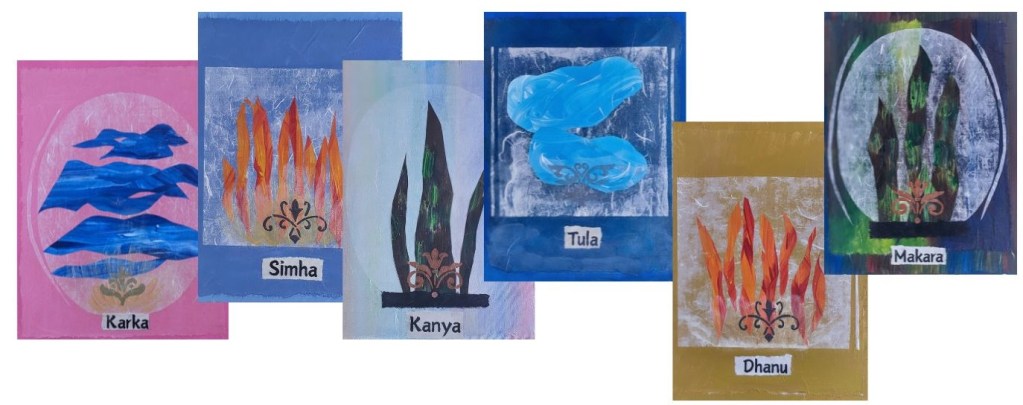
Unlike modern astrology systems, which often focus primarily on identity traits, Jyotish views the Rāśhis as energetic fields connected to nature, time, karma, elemental balance, and consciousness itself. Every Rāśhi contains a combination of elements, modality, planetary rulership, guna, motivation, and symbolic imagery that together create a unique energetic signature. These qualities influence how energy moves, where attention is directed, and how experiences are interpreted.
Within the Jyotish Tarot deck, the Rāśhis act as archetypal mirrors. When a Rāśhi card appears in a reading, it may reflect the current state of mind, a dominant emotional atmosphere, a behavioral tendency, or the energetic tone surrounding a situation. The card may reveal strengths already available within the individual, or it may highlight areas requiring awareness, balance, or refinement.
The imagery within the cards is intentionally designed to communicate these subtle energetic principles visually. Color, shape, texture, symbolic arrangement, and compositional balance all contribute to expressing the inherent nature of the Rāśhi. A fixed sign may contain stable geometric structures or enclosed forms, while a movable sign may feature directional movement or expanding space. Fire signs may carry sharper contrast, intensity, or radiating forms, while water signs may appear fluid, layered, reflective, or atmospheric. These visual elements are not decorative; they are part of the deck’s interpretive language.
One of the unique aspects of Jyotish Tarot is that the cards are not approached through rigid prediction alone. The Rāśhis work through synchronicity, reflection, and symbolic resonance. A card drawn at a particular moment often reveals the energetic pattern most active within consciousness at that time. This allows the reading to serve not only as guidance but also as a form of self-recognition.
For example, a fiery Rāśhi appearing in a reading may indicate initiative, courage, purification, passion, or action. In another context, the same energy may reveal impatience, burnout, aggression, or excessive force. An earth-based Rāśhi may bring stability, patience, and groundedness, yet in imbalance may manifest as stagnation, attachment, or resistance to change. The cards, therefore, invite observation rather than immediate judgment.
The Upright and Reversed meanings within the deck further deepen this process. Upright expressions generally reflect the natural flow or balanced expression of the Rāśih’s energy. Reversed expressions do not indicate something “bad,” but instead may point toward imbalance, internalization, blockage, excess, or energy seeking refinement. In many cases, the reversal becomes an invitation to strengthen awareness and restore energetic harmony.
Working with the Rāśhis over time gradually develops intuitive recognition. Readers begin noticing recurring energetic patterns within themselves and others. Certain Rāśhis may repeatedly appear during periods of growth, transition, healing, creativity, or challenge. Over time, the symbolic language becomes increasingly personal, allowing the reader to form a direct relationship with the consciousness embedded within the cards.
Jyotish Tarot ultimately bridges structured wisdom with intuitive perception. The Rāśhis provide the framework, while the imagery, synchronicity, and the reader’s awareness bring the interpretation to life. Rather than memorizing fixed meanings alone, the reader learns to experience the energetic essence of each Rāśhi directly through symbol, reflection, and inner recognition.
Leave a Reply