
Intuition is often described as an inner knowing — a quiet perception that arises before logic fully explains it. Both tarot and Jyotish, the traditional system of Vedic astrology, have long been used as tools for developing this deeper awareness. When combined together through Jyotish Tarot, they create a unique pathway for expanding intuition through symbolism, reflection, synchronicity, and conscious observation.
Unlike purely analytical systems, Jyotish Tarot encourages a balance between structure and inner perception. The Grahas, Rāśis, and Bhāvas provide symbolic foundations rooted in ancient astrological wisdom, while the tarot-like experience of drawing cards invites the reader into a direct and personal relationship with intuition itself. Over time, the mind begins to recognize patterns not only intellectually, but energetically and emotionally.
One of the most powerful aspects of Jyotish Tarot is the way it shifts awareness away from rigid prediction and toward deeper perception. A reading becomes less about forcing answers and more about observing what naturally arises. The card a person is drawn to, the imagery they notice first, the emotions that surface, or the repeating themes across multiple readings can all become part of the intuitive process. Even subtle details — color, shape, texture, symbols, or atmosphere within the artwork — may trigger insight beyond written interpretations.
Jyotish Tarot also deepens intuition through synchronicity. The cards are not viewed as random in the ordinary sense, but as meaningful reflections arising through timing, consciousness, and energetic alignment. A reader may ask a question and draw a card that unexpectedly mirrors an inner struggle, hidden desire, or emerging opportunity. Over time, repeated experiences like this begin to strengthen trust in intuitive perception.
Another important aspect of intuition is self-awareness. Jyotish Tarot naturally encourages reflection on personal habits, emotional patterns, fears, strengths, relationships, and cycles of growth. Through this process, readers often become more sensitive not only to symbolic meaning, but also to their own inner responses. Intuition grows stronger when a person learns to observe themselves honestly and without distraction.
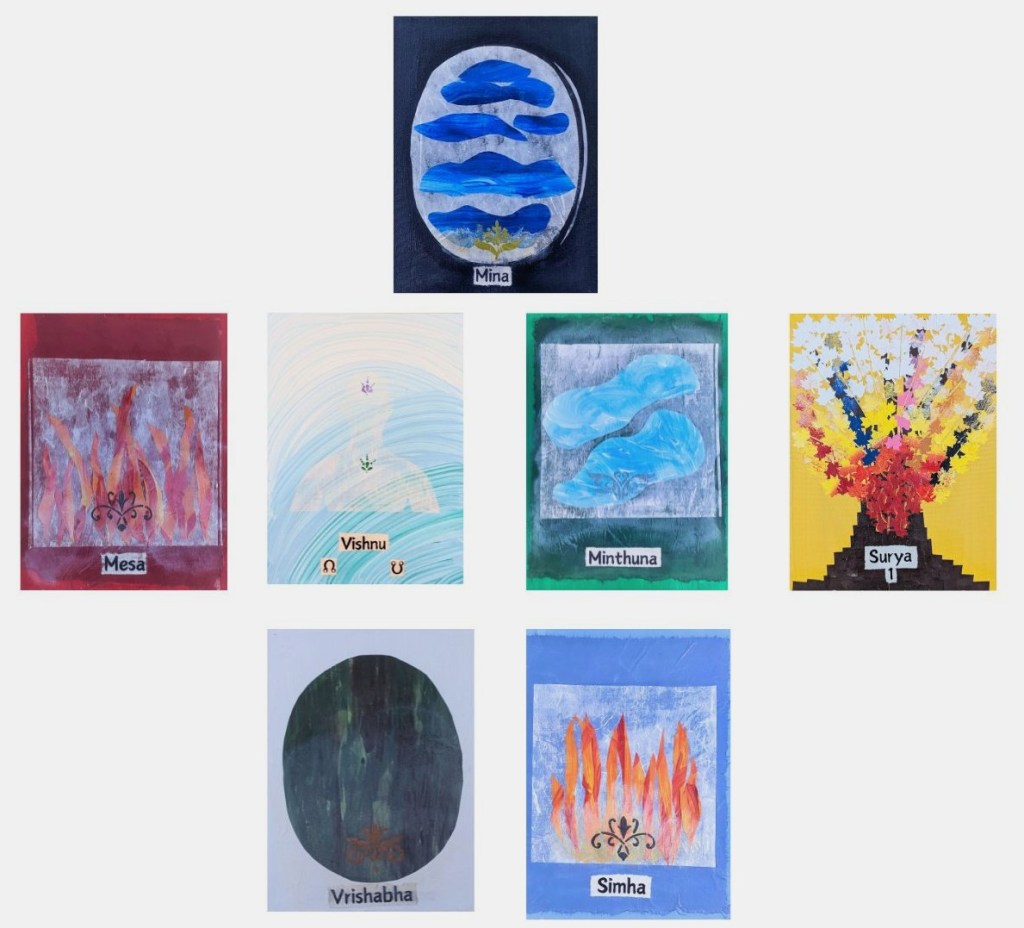
The imagery within Jyotish Tarot can also play an important role in expanding intuitive awareness. Handmade collage art, layered symbolism, planetary associations, colors, sacred geometry, and encoded philosophical concepts invite the subconscious mind to engage with the cards beyond literal interpretation. Rather than simply memorizing meanings, the reader gradually develops a living relationship with the symbols themselves.
Developing intuition is rarely instantaneous. Like meditation, music, or any creative discipline, it strengthens through consistent practice. Simple exercises such as daily card pulls, quiet reflection, journaling impressions, meditating on imagery, or observing recurring themes can gradually heighten intuitive sensitivity. Over time, the reader often notices greater clarity, stronger instinctive perception, and a deeper trust in their inner guidance.
Jyotish Tarot ultimately becomes more than a reading system. It becomes a practice of conscious observation — a way of listening more carefully to symbolism, timing, emotion, synchronicity, and the subtle language of the inner self. Through repeated interaction with the cards and their meanings, intuition begins to expand naturally, blending ancient wisdom with direct personal experience.
Read what Psychology Today says about intuition.
The difference between intuition and anxiety.
Leave a Reply