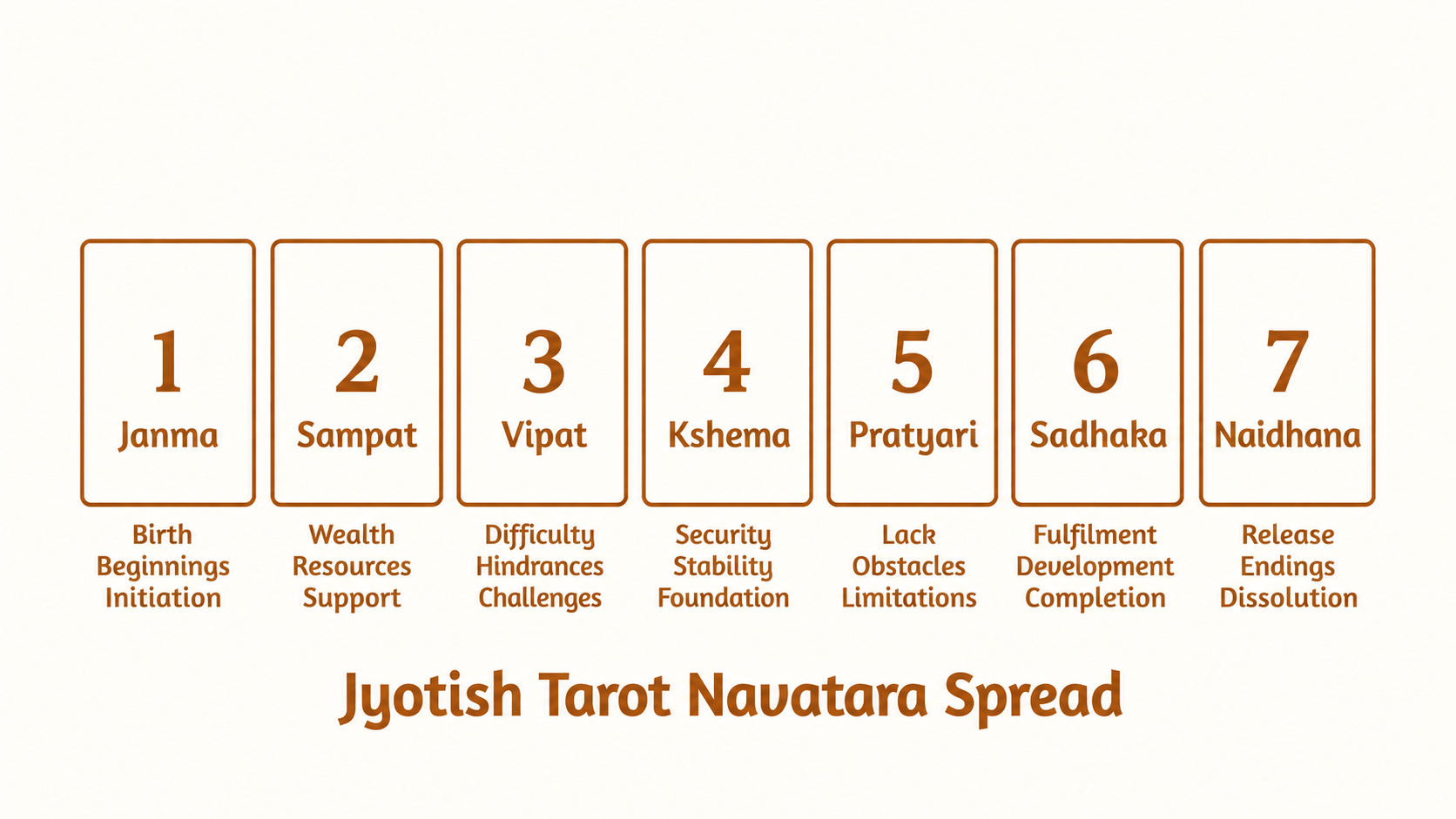
The position of a card is an important part of a Jyotish Tarot spread. The card tells us what is involved, while its position helps us understand what is happening with it.
One of the traditional Jyotish systems I use to give meaning to these card positions is Navatara.
What Is Navatara?
The Navatara system is connected to the nakshatras, the 27 stellar constellations used in Jyotish. Traditionally, beginning with the nakshatra of the natal Moon, the 27 nakshatras are organized into three groups of nine. Each position in this repeating sequence has its own meaning.
These nine positions are Janma, Sampat, Vipat, Kshema, Pratyari, Sadhaka, Naidhana, Maitra, and Parama Maitra.

In Jyotish Tarot, I use these traditional meanings to give the positions in a card spread their own character. This adds another layer of information to a reading because we are not only looking at the meaning of the card. We are also looking at where the card appears.
For now, let’s look at the first seven positions used in this Jyotish Tarot spread.
1 — Janma: Birth and Beginnings
Janma represents birth and beginnings.
The card in this position shows what is beginning, emerging, or setting the situation in motion. It gives us a starting point for understanding the rest of the reading.
2 — Sampat: Wealth and Resources
Sampat represents wealth, resources, and support.
The card in this position shows what is available to us. This could be money, but it can also be another kind of resource—something useful, supportive, or valuable that we can draw upon.
3 — Vipat: Hindrances
Vipat represents difficulty, hindrances, and challenges.
The card in this position helps us see what may be creating frustration, conflict, or getting in the way. The card gives us more information about the nature of the difficulty and how it is affecting the situation.
4 — Kshema: Security and Stability
Kshema represents security, stability, and foundation.
The card in this position can show what gives us a firm foundation or provides a sense of security. It can also show what helps the situation remain stable and allows us to function at our best.
5 — Pratyari: Lack and Obstacles
Pratyari represents lack, obstacles, and limitations.
The card here can show where something is missing or where we are not finding the fulfillment we need. Recognizing this can encourage us to make an adjustment, change direction, or move toward something more fulfilling.
6 — Sadhaka: Fulfillment
Sadhaka represents fulfillment, development, and completion.
The card in this position shows something we recognize as worthwhile. Because we see its value, we may be willing to develop it, improve it, or put in the effort necessary to bring it to completion.
7 — Naidhana: Release, Endings, and Dissolution
Naidhana represents release, endings, and dissolution.
The card in this position can show what is ending, separating, dissolving, or no longer continuing in its present form.
An ending does not automatically tell us whether something is positive or negative. The card itself helps us understand what is being released and what that ending means within the reading.
How Navatara Adds Meaning to a Jyotish Tarot Spread
When the seven cards are laid out together, each one has a specific job to do.
The same Jyotish Tarot card can therefore tell us something quite different depending on where it appears.
For example, a card in Sampat may show a resource or something valuable that is available to us. That same card in Vipat may reveal a source of difficulty. In Sadhaka, it may show something worth developing, while in Naidhana, it may show something that is ending or being released.
This gives us a simple way to understand how the system works:
The card tells us what is involved. The Navatara position tells us what is happening with it.
By combining the meaning of the card with the meaning of its position, we can add more detail and context to a Jyotish Tarot reading. This can also help fine-tune a prediction, because we can see more clearly the role each card may play as events unfold.
Leave a Reply